

The New Zealand Leader's Guide to DISC Profiling
Everything DiSC for Leaders is a behavioural profiling tool designed specifically for people in leadership roles. It shows New Zealand leaders how their natural style affects the people they lead — and gives them a practical framework for communicating more effectively, developing their direct reports, and building stronger leadership teams.
Unlike general personality assessments, Everything DiSC for Leaders maps your behaviour against eight leadership-specific priorities, so the insights are immediately applicable to how you lead — not just how you work.
This guide is written for New Zealand leaders who want to use DISC purposefully, not just as a one-off team exercise. Whether you lead a small team in Wellington or an organisation operating from Whangarei to Invercargill, the principles are the same: self-awareness leads to better leadership, and better leadership builds stronger teams.
Everything DiSC is published by Wiley and used by more than 45 million people across 72 countries, including over 70% of Fortune 500 companies. The median reliability alpha across Everything DiSC instruments is .87 — a standard few behavioural tools reach.
How Does DISC Profiling Help Leaders?
DISC profiling helps leaders in three specific ways: it shows how their natural behavioural style affects the people they lead, identifies where that style creates friction or disengagement, and gives them a practical framework for adapting their communication to get better results from every direct report.
Specifically, DISC shows you:
Where your natural leadership style creates energy and momentum
Where it creates friction, resistance, or disengagement — often without you realising it
How your direct reports are wired differently, and what they need from you to perform at their best
How to adapt your communication style deliberately, rather than defaulting to what feels natural to you
This is not about changing who you are. It is about understanding your defaults clearly enough to choose when to lean into them and when to adjust.
For more on what a DISC assessment involves, including what the profile measures and how it is completed, see our introduction to DISC Assessments.
The four DISC styles in a leadership context
Each of the four DISC styles has distinct leadership strengths and predictable blind spots. Most leaders are a blend of two or three styles, with one or two dominant.
D — The Driving Leader
D-style leaders are decisive, direct, and results-focused. They move fast, set high expectations, and push through obstacles. Their teams often respect their clarity and confidence.
The blind spot: they can push so hard for results that they underinvest in relationships and overlook the concerns of more cautious team members. S and C-style team members in particular may feel unheard or steamrolled.
I — The Inspiring Leader
I-style leaders are energetic, collaborative, and optimistic. They are skilled at building enthusiasm, rallying a team around a vision, and making people feel valued and included.
The blind spot: they can avoid difficult conversations, overestimate buy-in, and leave detail-oriented team members frustrated by a lack of structure and follow-through
S — The Steadying Leader
S-style leaders are consistent, patient, and deeply loyal to their teams. They create psychological safety, follow through reliably, and often hold institutional knowledge and relationships together.
The blind spot: they can resist necessary change, avoid conflict past the point of usefulness, and struggle to make fast decisions under pressure — particularly when that pressure comes from D-style leaders or board stakeholders.
C — The Conscientious Leader
C-style leaders are analytical, precise, and quality-driven. They hold high standards, ask the right questions, and rarely act without adequate information. Their judgement is typically sound.
The blind spot: they can slow decision-making, struggle to communicate in the direct, emotionally resonant way that I and S-style team members need, and appear distant or overcritical when under pressure.
What is the best DISC style for leadership?
There is no single best DISC style for leadership. Research across Everything DiSC's 45 million+ users shows effective leaders in every style — what distinguishes them is self-awareness, not their profile.
The research is consistent, leaders who understand their own style and its impact on others are rated more effective by their teams than those who do not. Self-awareness is the variable that matters. DISC is the tool that builds it — start with our DISC personality test.
If your team has a strong concentration of one or two styles, understanding the collective pattern also matters. A leadership team heavy in D and I styles, for example, may move quickly and generate enthusiasm — but may underinvest in risk analysis and process quality. DISC makes these patterns visible before they become expensive.
How New Zealand leaders use DISC
In New Zealand we are not particularly direct leaders. Just like our Kiwi culture, we tend to avoid tension and conflict and find indirect ways to communicate difficult messages.
Because it provides clear, usable insights about others DISC is an excellent tool to help Kiwi leaders understand the most effective way to communicate with people they lead.
Understanding your direct reports
Knowing your own DISC style is useful. Knowing the styles of everyone who reports to you is significantly more useful. With that information, you can:
Adjust how you deliver effective feedback to each person
Structure 1-on-1 in a way that works for their style, not just yours
Understand why a team member is disengaged — and what you can do about it
Anticipate conflict before it surfaces by recognising style clashes in your team
Adapting your communication style
DISC gives leaders a practical method for adapting their communication style to each direct report — adjusting how they deliver feedback, set expectations, and handle conflict based on the other person's behavioural wiring, not just their own.
The most common failure is style mismatch: a D-style leader delivering blunt, rapid-fire feedback to a high-S team member is not being effective — they are being efficient at the cost of impact. DISC gives you the language and framework to communicate the same message in a way each person can actually receive.
Developing your team
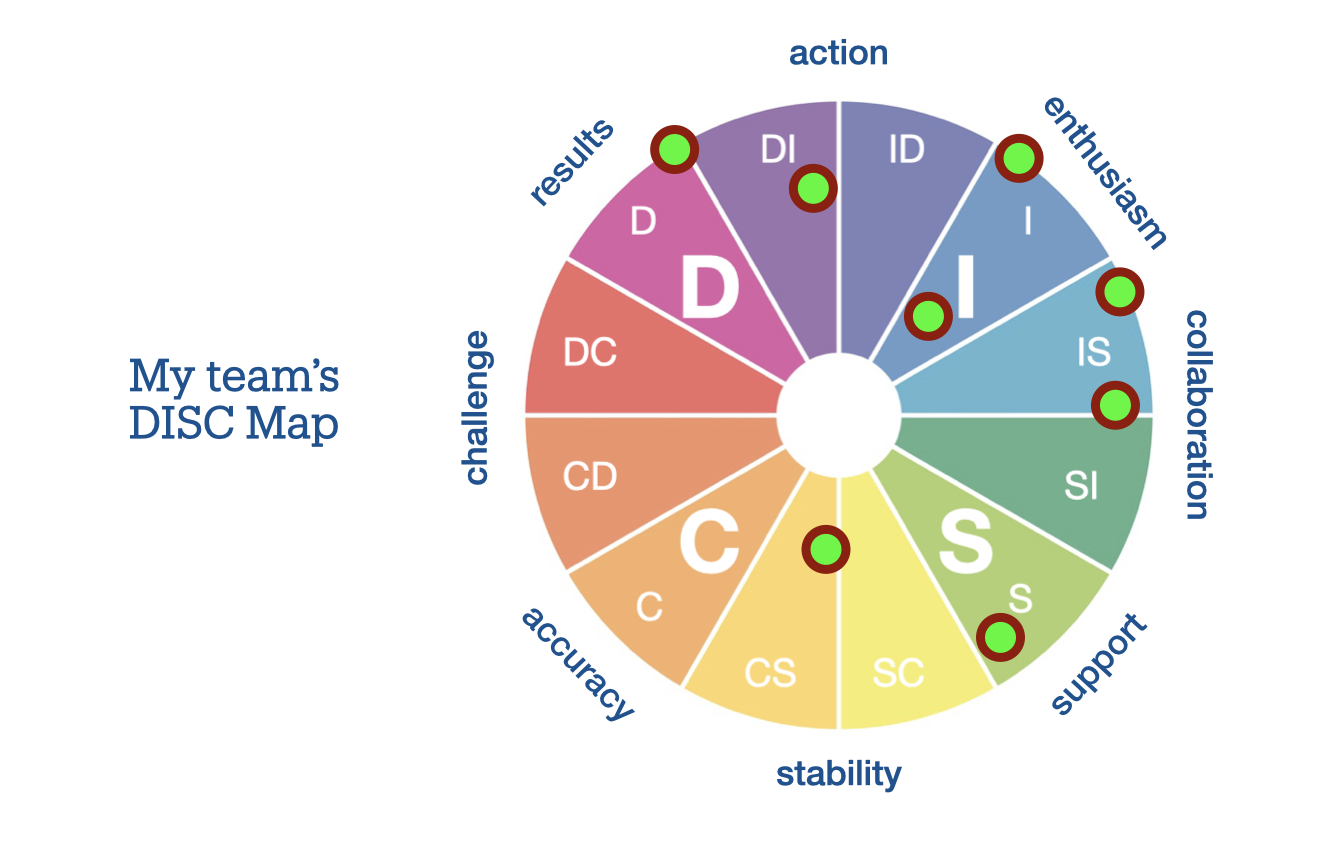
For senior leaders and HR professionals working with a team, Everything DiSC produces a group report — showing the collective style profile of the whole team, where the gaps are, and what those gaps mean for team dynamics.
At Archetype we create a DISC Map for leadership teams we work with.
These tools are provide powerful insights and direction for meaningful team development.
Everything DiSC for Leaders — what the profile includes
The Everything DiSC for Leaders profile is a dedicated instrument designed specifically for people in leadership roles. It differs from the standard Everything DiSC Workplace profile in important ways:
It maps your style against the Everything DiSC leadership model
It identifies your priorities as a leader — the behaviours and outcomes you naturally gravitate toward
It shows how your style affects each of the eight approaches to leadership effectiveness
It provides personalised strategies for developing your leadership across each approach
It includes a 360-degree companion tool (Everything DiSC 363 for Leaders) for those who want to integrate feedback from their team alongside their self-assessment
The report is between 20 and 27 pages depending on your style profile. The assessment is completed online in approximately 15–20 minutes.
Frequently asked questions
What is a DISC leadership style?
A DISC leadership style is the behaviour pattern a leader naturally defaults to — how they make decisions, communicate expectations, respond to conflict, and engage their team. Everything DiSC maps four primary tendencies in a leadership context: Dominance, Influence, Steadiness, and Conscientiousness. Most leaders show a blend of two or three, with one or two most prominent under pressure.
Which DISC style is best for leadership?
No single DISC style is best for leadership. Research across Everything DiSC's 45 million-plus users shows effective leaders in every style quadrant. What distinguishes them is self-awareness — understanding their style and its impact on others. Everything DiSC for Leaders is built around this: the goal is not to change your style but to lead more deliberately.
Can DISC help me develop my leadership team?
Yes — this is one of the most effective uses of DISC in New Zealand organisations. Everything DiSC produces group reports that map a leadership team's collective profile, identifying where strengths concentrate and where gaps exist. A team strong in D and I, for example, may excel at pace and vision but underinvest in risk management and process rigour..
How is Everything DiSC for Leaders different from a standard DISC profile?
Everything DiSC Workplace is designed for individual contributors and team members. Everything DiSC for Leaders is a distinct instrument for people in leadership roles — it maps leadership-specific priorities, provides development strategies across eight dimensions of effectiveness, and is designed as the foundation for coaching or development programmes. Both measure the same behavioural tendencies through different lenses.