

DISC Profiling for New Zealand Teams
Everything DiSC Workplace is a behavioural profiling tool used by New Zealand teams to understand how each team member is wired to communicate, respond to pressure, and collaborate — and to use that understanding to work together more effectively.
A DISC workplace profile does not measure skills, intelligence, or performance. It maps behavioural tendencies across four styles — Dominance, Influence, Steadiness, and Conscientiousness — and shows each team member how their natural style interacts with the styles of the people around them.
Everything DiSC is published by Wiley used by more than 45 million people across 72 countries, and is the most widely researched behavioural profiling system available to New Zealand organisations today.
What Does a DISC Workplace Profile Show a Team?
A DISC workplace profile gives each team member three things: a clear picture of their own behavioural style, an understanding of how that style affects their colleagues, and practical strategies for adapting their approach to work more effectively with people in the team who are wired differently.
At the team level, Everything DiSC produces a Group Culture Report — mapping the collective profile of the whole team on a single DISc circle. This shows:
Where the team's natural strengths concentrate
Which styles are underrepresented and what that means for team performance
Where style clashes are most likely to occur and why
How the team tends to approach conflict, decision-making, and change
Here’s an example Group Culture Report diagram …
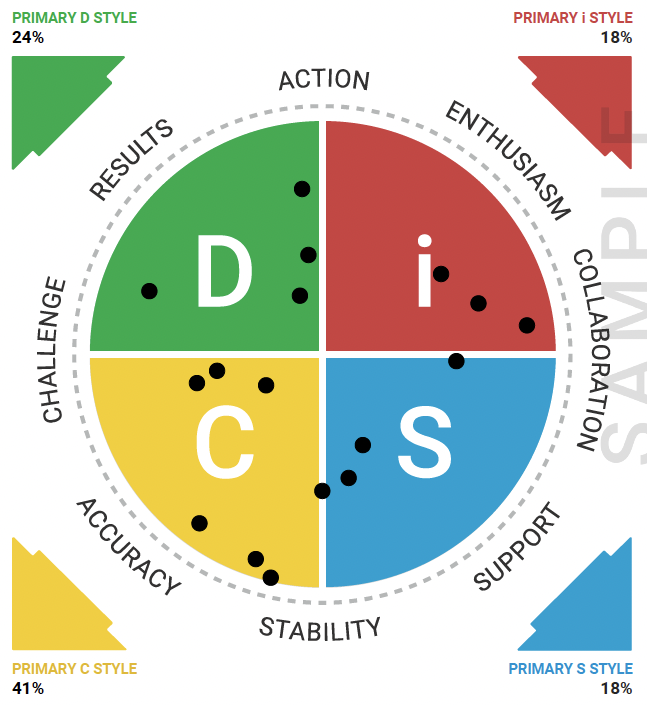
A team with a strong D and I profile, for example, will move fast and generate enthusiasm — but will typically underinvest in risk management, process quality, and the concerns of more cautious team members. Making that pattern visible is the first step to addressing it.
How Teams Use DISC
Improve team communication
DISC gives teams a shared language for behavioural difference — one that is descriptive rather than judgemental. Instead of "she's too slow" or "he never listens," teams learn to recognise style differences as predictable and manageable. D-style team members communicate directly and move fast. S-style team members need time to process and prefer collaborative decisions. Neither is wrong — but without a shared framework, the friction between them is chronic and largely invisible.
Reduce workplace conflict
Most workplace conflict is not personality-driven — it is style-driven. Two people with incompatible DISC styles will generate friction in predictable, recurring patterns until they understand why it is happening. DISC makes the source of that friction visible and gives both parties a language and strategy for navigating it. New Zealand HR professionals report that DISC-based team sessions consistently surface and resolve tensions that have been present for months or years.
Onboard new team members
DISC is particularly effective at the point a new person joins a team. Understanding the new team member's style — and sharing the existing team's collective profile — accelerates the integration process and reduces the trial-and-error period that typically accompanies new hires. It is faster and more evidence-based than waiting for interpersonal dynamics to emerge organically.
Leadership team development
For leadership teams specifically, Everything DiSC produces a group report that maps how the collective leadership style affects the organisation beneath it. A leadership team concentrated in C and S styles, for example, will be thorough and stable — but may be slow to act, conflict-averse, and resistant to bold strategic moves. DISC makes that pattern explicit so the leadership team can compensate deliberately rather than unknowingly.
What is DISC Team Building?
DISC team building is the process of using individual DISC profiles and a group team report to improve how a team works together. It typically involves a facilitated session where team members complete their DISC profiles, receive their individual reports, and then work through their collective team map as a group.
A well-facilitated DISC team session covers:
Each team member's DISC style and what it means for how they work
The team's collective profile — where strengths concentrate and where gaps exist
Common friction points between styles represented in the team
Practical agreements about how the team will communicate, make decisions, and handle conflict going forward
DISC team building is used by New Zealand organisations across government, financial services, professional services, education, and healthcare — from small teams of five to leadership groups of fifty.
Developing a leadership team
For leadership teams specifically, the Everything DiSC Work of Leaders Group Report maps the team's collective tendencies across Vision, Alignment, and Execution — showing where the group's combined style creates natural strength and where it creates predictable risk.
A leadership team concentrated in C and S styles, for example, will be thorough and stable — but may be slow to act, conflict-averse, and resistant to bold strategic moves. DISC makes that pattern explicit so the leadership team can compensate deliberately rather than unknowingly.
How to Introduce DISC to Your Team
The most effective way to introduce DISC to a team is through a facilitated session rather than self-directed completion. When team members complete their profiles independently without context or debrief, the insights rarely translate into changed behaviour. A skilled facilitator makes the difference between a profiling exercise and a genuine shift in how the team operates.
The process is straightforward:
Each team member completes their Everything DiSC Workplace profile online — approximately 15–20 minutes
Each person receives their individual report — 20 pages covering their style, priorities, and strategies for working with other styles
A facilitator runs a team session using the group report — typically two to four hours depending on team size and depth required
The team leaves with a shared language, visible agreements, and an ongoing reference point for navigating style differences
For New Zealand teams considering DISC for the first time, enquiring about a facilitated session before purchasing individual profiles is the recommended starting point.
Frequently asked questions
What is a DISC workplace profile?
A DISC workplace profile maps an individual's natural tendencies across four dimensions — Dominance, Influence, Steadiness, and Conscientiousness. Everything DiSC Workplace is designed specifically for professional settings, showing each person how their style affects colleagues, what they need to perform at their best, and how to adapt when working with people who are wired differently.
How many people on a team need to complete DISC for it to be useful?
A minimum of three to four people is needed to generate a meaningful team map. Everything DiSC has been used with leadership teams of fifty and cross-functional groups of several hundred. The most effective team sessions involve eight to twenty participants — enough style diversity to make the group profile genuinely instructive, without the session becoming unwieldy.
How is DISC team building different from a standard team-building activity?
Standard team-building builds familiarity and goodwill — it does not change how a team communicates or makes decisions. DISC team building is evidence-based: it starts with real behavioural data, maps the team's collective profile, and provides practical tools for resolving specific friction points. The insights are permanent and the framework remains useful long after the session ends.
How do I introduce DISC to a leadership team?
Have each leader complete their Everything DiSC Work of Leaders profile individually before the group session. A Work of Leaders Group Report can then be generated, giving the team a composite view of their collective tendencies across Vision, Alignment, and Execution. The session then focuses on what those patterns mean for how they lead — not on individual orientation.